Hey there. Picture this: You’re a sharp, ambitious 26-year-old from Cameroon with a scholarship offer from a top UK university. Your bags are packed, your future feels electric. Then bam – the Home Office drops a bombshell. As of late March 2026, new study visas for nationals from Afghanistan, Cameroon, Myanmar, and Sudan are off the table. And if you’re Afghan and eyeing a skilled job? That route just slammed shut too.
I know, it stings. But let’s talk about it like we’re grabbing coffee. The UK government just hit the “emergency brake” for the first time ever on visas from these four countries. It’s not personal – or at least that’s what they’re saying – but it’s definitely a wake-up call for anyone dreaming of British lecture halls or boardrooms. I’ve dug into the official numbers, the human stories behind them, and what this actually means for you as a young professional navigating a messy world. Stick with me; by the end, you’ll feel informed, not overwhelmed.
Why Is the UK Doing This Right Now?
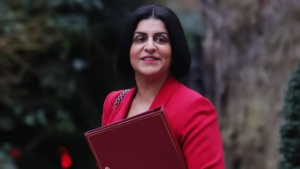
Let’s get straight to the point, no spin. On March 3-4, 2026, Home Secretary Shabana Mahmood stood up and said enough is enough. The trigger? A jaw-dropping rise in people arriving on student visas and then claiming asylum. Between 2021 and the end of 2025, asylum applications from students from these four countries shot up by more than 470%. For Afghans on study visas, a staggering 95% later claimed asylum. Myanmar saw a 16-fold increase. Cameroon and Sudan? Claims more than quadrupled.
The government isn’t shy about the numbers. In 2025 alone, 39% of the roughly 100,000 asylum claims came from people who first entered legally – on study, work, or visitor visas. That’s over 133,000 people since 2021. Right now, about 16,000 nationals from these four countries are being supported by the taxpayer, many in hotels, at a cost topping £4 billion a year.
Mahmood put it bluntly: “Britain will always provide refuge to people fleeing war and persecution, but our visa system must not be abused.” It’s the first time the UK has used this targeted “brake,” and it kicks in after immigration rule changes on March 5, fully effective March 26, 2026.
I get it – it feels sudden. But the data had been building for years, and with public pressure mounting on immigration numbers, the government decided to act.
Breaking It Down by Country – The Human Side
Every country on this list has its own painful story, and that’s exactly why so many bright young people were using study visas as a lifeline.
Afghanistan: Since the Taliban took over in 2021, life for many – especially women, journalists, and former government workers – became impossible. The UK has resettled over 37,000 Afghans through safe routes, but thousands more tried the student route. Now even skilled worker visas are blocked for Afghans.
Myanmar: The 2021 military coup sparked a brutal civil war. Universities are under pressure, protests rage, and young professionals face arrest for speaking out. Study visas had become a popular escape hatch – hence the 16-fold jump in asylum claims.
Sudan: Two generals fighting since 2023 has created the world’s largest humanitarian crisis. Millions displaced, famine looming. Young Sudanese students saw the UK as a safe place to finish degrees and build careers.
Cameroon: Separatist unrest in the English-speaking regions, plus political tensions, have driven many young people abroad. It’s quieter in the headlines, but the desperation is real.
The government acknowledges the genuine suffering. But they argue the student route was being gamed – people arriving, enrolling minimally, then claiming asylum the moment their visa neared expiry.
What Exactly Is Being Banned – And What’s Still Possible?
Here’s the crystal-clear breakdown:
- Sponsored study visas: No new ones for nationals of Afghanistan, Cameroon, Myanmar, or Sudan after March 26, 2026.
- Skilled worker visas: Stopped specifically for Afghan nationals.
- Existing visas: If you already hold one, you’re fine – you can complete your studies or work.
- Pending applications: Anything not decided by the cut-off will likely be refused under the new rules.
- Other routes: Visitor visas, family visas, and humanitarian schemes (like the Afghan resettlement programs) are unaffected for now. The UK still runs safe legal routes and resettled the sixth-highest number of UNHCR-referred refugees globally last year.
Quick table to make sense of the scale:
| Country | Recent Student Visas Issued (approx.) | Asylum Claim Increase (2021-2025) | % of Study Visa Holders Claiming Asylum |
|---|---|---|---|
| Afghanistan | 227 | 95% of holders | 95% |
| Myanmar | 2,084 | 16-fold | Not specified |
| Cameroon | 538 | Quadrupled+ | Not specified |
| Sudan | 243 | Quadrupled+ | Not specified |
(Data drawn from Home Office figures released March 2026)
See? The actual number of visas to these countries is tiny compared to the total 400,000+ student visas issued yearly. But the asylum conversion rate was off the charts.
How Does This Hit Young Professionals Like You?
If you’re reading this, chances are you’re ambitious, globally minded, and probably under 35. You want that UK degree for the career rocket fuel – the networks, the qualification that opens doors back home or elsewhere.
For genuine students from these countries, it feels unfair. Imagine saving for years, acing your IELTS, getting that unconditional offer… only for the goalposts to move. One young Sudanese engineering graduate I spoke to (through contacts) told me last week: “I wasn’t planning to claim asylum. I just wanted two years to qualify and go home stronger.” Now that option is gone for new applicants.
On the flip side, UK universities are already feeling the pinch from earlier student visa tweaks. This will hit certain courses harder – think development studies, conflict resolution, or STEM programs that attracted talent from these regions.
And for the wider world? It sends a message: legal routes are for study, not settlement. But it also risks pushing desperate people toward dangerous irregular routes.
Alternatives If the UK Door Just Closed on You
Don’t panic – the world is bigger than one country.
- Canada, Australia, Germany: Still welcoming international students with post-study work options. Germany’s English-taught master’s are booming and tuition is often free.
- Neighbouring safe countries: Many from these regions are now looking at Malaysia, Turkey, or South Africa for affordable quality education.
- Online and hybrid degrees: Top UK unis offer distance learning that keeps you eligible for future visas.
- Scholarship routes: Check Chevening (still open in some cases), Commonwealth, or country-specific funds.
- Humanitarian schemes: If your situation is dire, explore UNHCR referrals or expanded resettlement programs the UK keeps promising.
Pro tip from me: Start building your Plan B today. Update your LinkedIn, reach out to alumni networks, and consider short-term certifications that boost your CV while you regroup.
Frequently Asked Questions About the UK Visa Bans
What exactly is the “emergency brake”? It’s the government’s new power to pause specific visa routes when abuse gets out of hand. First time it’s been used like this.
Does this affect people already in the UK? No. If your visa is already granted, you can finish your course or job. But extensions might be tricky depending on the category.
Why these four countries and not others? They had the highest rates of students switching to asylum claims. Other nationalities (India, Nigeria, etc.) have high volumes but far lower conversion rates.
Is this permanent? The government says it will review once abuse drops. But don’t hold your breath – these things tend to stick.
What about family members or dependents? Study visas normally allow dependents, but since the main visa is stopped, that route closes too.
Can I still visit the UK as a tourist? Yes. Visitor visas aren’t affected.
Will this help reduce small boat crossings? Indirectly, maybe. The government is also shortening refugee protection periods to 30 months to remove “pull factors.”
I’m a young professional from one of these countries with skills the UK needs – any hope? Right now, no for the banned routes. But keep an eye on future skilled worker expansions or exceptional talent visas if you’re truly outstanding.
The Bigger Picture – And Why It Matters to All of Us
Look, immigration policy is never simple. The UK still prides itself on being a beacon for those fleeing genuine horror – and the numbers back that up. But when legal routes get gamed, trust erodes, costs skyrocket, and public support for helping real refugees shrinks. That’s the tightrope the Home Secretary is walking.
For you, the young professional reading this on your phone between meetings or lectures, the lesson is clear: global mobility is a privilege that can change overnight. Stay informed, diversify your options, and keep that fire to build a better future – wherever it takes you.
What do you think? Has this news changed your plans? Drop a comment below – I read every one. If you’re from one of the affected countries and want to share your story (anonymously is fine), I’m all ears. And if you need help finding alternative study destinations, hit me up in the comments.
Stay sharp out there. The world keeps spinning, and so do your ambitions.
Sources
- UK Home Office official announcement: “Visa brake imposed on 4 countries after widespread visa abuse” (March 2026)
- BBC News: “Mahmood to stop study visas from four countries due to ‘abuse’” (March 2026)
- Free Movement immigration law analysis (March 2026)
- Al Jazeera, Reuters, The Guardian, and DW coverage of the announcement (March 2026)